









PAX Global Announces 2025 Annual Results
Profit for the year reaches HK$ 756 million, up 5% year-on-year
Global adoption of Android Smart solutions expands, representing over 70% of revenue
PAX Global Technology Limited (“PAX” or the “Group”, HKSE stock code: 00327.HK), one of the world’s leading providers of electronic payment terminal (“E-payment terminal”) solutions and related services, is pleased to announce the audited annual results for the year ended 31 December 2025.
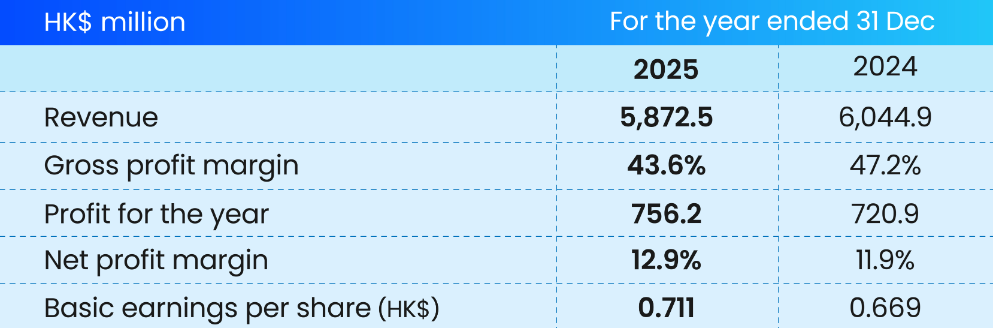
As the global shift toward cashless payments continues, ongoing merchant digital transformation and the expanding adoption of Android smart payment terminals across retail, hospitality and other segments underpin medium to long-term demand for modern payment infrastructure. Despite ongoing macroeconomic uncertainty in 2025, PAX maintained stable operations. Revenue amounted to HK$5,872.5 million. Profit for the year amounted to HK$756.2 million, with a net profit margin of 12.9%, demonstrating the Group’s ability to sustain profitability and operational resilience across economic cycles. Net cash generated from operating activities reached HK$1,304.5 million, highlighting the Group’s strong cash flow generation.
In the second half of 2025, shifts in global semiconductor supply and demand created upward pricing pressure on certain components, particularly memory chips, bringing significant cost challenges to the industry. Market consensus expects this trend to continue into 2026. Meanwhile, macroeconomic uncertainties such as tariffs and currency fluctuations remain. In view of these factors, PAX have been assessing our overall capital allocation and cash management strategy. The Board has therefore resolved not to recommended the final dividend for the year ended 31 December 2025.
Mr. Tom LUO, Chief Executive Officer of PAX, commented, “Leveraging its broad payment terminal portfolio and global sales and partner network, PAX continues to prioritize key markets, including the United States, Europe and Japan. Long-standing relationships with acquiring banks, Payment Service Providers (“PSPs”) and channel partners have further strengthened the Group’s position within the payment ecosystem.”
Scaling Android payment terminal portfolio for high-growth use cases
As payment infrastructure continues to modernize globally, Android payment terminals are increasingly serving as digital interfaces for payment acceptance and operational management. With Android devices at the core of its offering, the Group expands its product portfolio across handheld, countertop and unattended solutions, enabling rapid deployment across a broad range of industry use cases. During the year, PAX further expanded its product lineup with the launch of models including the A950, A6630 and A77 PCI PTS POI v7.0, and notably launched an enhanced A920Pro featuring an additional customer-facing display. This positions the Group to capture potential replacement demand for first-generation A920Pro units.
PAX Android payment terminal portfolio continues to gain adoption among leading banks and PSPs across multiple regions. Deployments span high-frequency transaction environments such as retail and hospitality, as well as high-traffic, operationally demanding settings including major sports venues, international events and transportation hubs such as airports and railway systems. These use cases impose elevated requirements for system stability, processing reliability and operational continuity. In 2025, Android products accounted for over 70% of Group revenue, marking a key milestone in the PAX strategic evolution toward an Android-centric portfolio.
The Group continues to strengthen its Android terminal portfolio through ongoing security certifications and functional upgrades. The A920Pro, widely recognized as one of the industry’s most iconic smart payment terminal designs, has achieved compliance with the latest industry standards, including PCI PTS POI v7.0 and EMVCo Contactless Kernel C-8. These certifications highlight strong security capabilities
while helping acquiring banks and PSPs reduce integration complexity and facilitate smoother adoption of future regulatory requirements and industry standard migrations.
Building a scalable SaaS platform to empower the payment ecosystem
Building on its extensive global deployment of Android payment terminals, PAX continues to advance MAXSTORE as the core of its SaaS offering. MAXSTORE provides an integrated suite of services including centralized terminal management, application distribution, Remote Key Injection (RKI), remote technical support and operational analytics. The platform enables acquiring banks, PSPs and channel partners to improve operational efficiency and reduce complexity in large-scale, multi-regional terminal deployments. MAXSTORE has achieved Payment Card Industry Data Security Standard (PCI DSS) certification, meeting stringent international data security requirements, and supporting the scalable, sustainable expansion of the Group’s platform services.
As at 31 December 2025, MAXSTORE was connected to over 16 million payment terminals worldwide, with connected device base and service capabilities continuing to expand. In parallel, the Group is integrating artificial intelligence (AI) into the platform to enhance terminal monitoring, support workflow optimization and operational data analytics, further improving overall platform service efficiency.
Europe, the Middle East and Africa (EMEA)
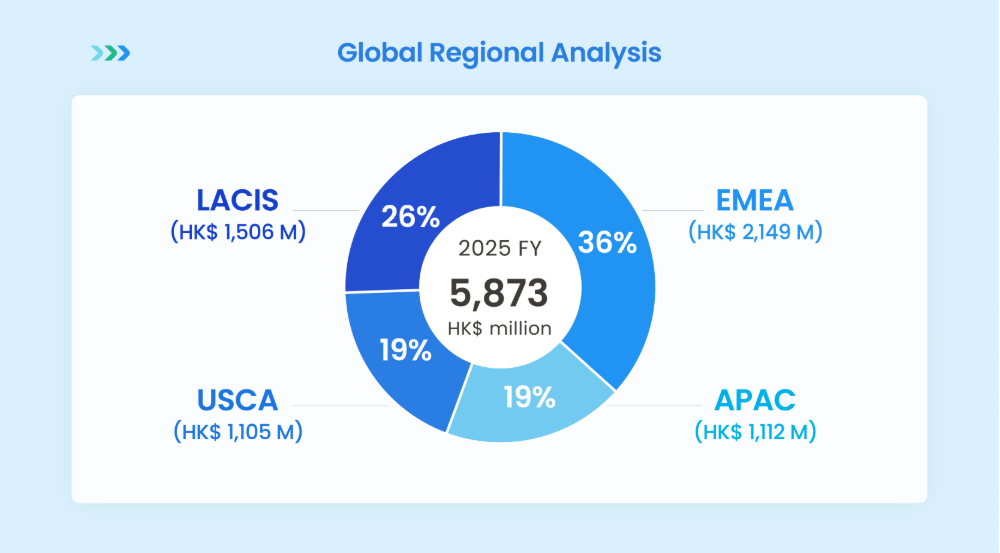
EMEA remained the Group’s largest revenue contributor in 2025, with sales exceeding HK$2,148.7 million. Performance across Europe remained resilient, with steady demand across core markets. The United Kingdom, Germany and Eastern Europe delivered solid sales despite market-specific fluctuations. As adoption of portable A-series payment models matured across Europe, the Group strengthened collaboration with local banks, PSPs and system integrators, driving deployments of the A920Pro and A35 across major markets. During the year, the UK also led early commercial adoption of the A6650 in retail and hospitality sectors.
In the Middle East and Africa, government-led digitalization initiatives continued to support demand for electronic payment acceptance solutions. PAX further expanded its market presence across Africa. Egypt and South Africa emerging as strategic growth markets where Android based payment terminal deployments increased meaningfully and delivered strong sales performance.
Latin America and the Commonwealth of Independent States (LACIS)
In Latin America, macroeconomic volatility and intensified competition led some customers to adopt a more cautious approach to terminal deployment, resulting in slower project execution and pressure on regional performance. LACIS revenue amounted to HK$1,506.3 million in 2025.
From a medium- to long-term perspective, the region continues to demonstrate structural growth potential, supported by ongoing digital payment adoption and increasing payment terminal penetration among small and medium-sized merchants. The Group will further strengthen its regional footprint with Android payment terminal portfolio, expanding channel reach and strategically allocating resources to high potential markets.
Asia Pacific Region (APAC)
In 2025, continued fintech investment and accelerated payment infrastructure upgrades across Asia Pacific enhanced regional deployment efficiency and execution capabilities, sustaining market momentum. PAX further deepened its APAC footprint, progressing steadily across markets. During the year, APAC revenue amounted to HK$1,112.5 million. Japan remained the region’s primary revenue contributor, with softer demand in parts of Southeast Asia due to macroeconomic headwinds and extended sales cycles.
In Japan, PAX strengthened its market presence through diversified Android product portfolio, achieving meaningful gains in market penetration. Supported by ongoing cashless payment policy initiatives and the expansion of vertical use cases, banks and PSPs accelerated deployment of the A920MAX, driving nearly a doubling of sales year-on-year in Japan. Deployments also expanded beyond retail and hospitality into transportation-related use cases, including taxis, railways and airports.
In Australia, the Group advanced product certification and enhanced local service capabilities, strengthening its position within the local payment ecosystem and creating additional momentum for long-term growth in the APAC region.
The United States of America and Canada (USCA)
In 2025, North America continued to serve as a key growth engine for the Group, delivering 24.3% sales growth and reaching a record annual revenue of HK$1,105.0 million. As contactless payments gained further adoption,
the Group deepened collaboration with banks, PSPs and independent software vendors (ISVs), supporting payment infrastructure across a broad customer base, ranging from large national retailers to small and mid-sized merchants.
Deployment of the Group’s Android A-series payment devices expanded further across the region, reinforcing PAX position within the North American payment ecosystem. Flagship models including the A920Pro, A35 and A800 delivered strong shipments, with deployments across high-volume environments such as retail, quick-service restaurant chains and major sports venues. Rising demand for integrated payment and operational solutions also drove steady order growth for PAX Android-based EPOS Workstation products.
During the year, PAX advanced next-generation payment technologies in North America through a strategic partnership with a biometric payment platform provider. The collaboration integrates biometric authentication features into PAX Android payment terminals, enhancing transaction security and improving user convenience in the market.
Mr. Tom LUO, Chief Executive Officer of PAX, commented, “As the global shift toward cashless payments continues, acquiring banks and PSPs are increasingly prioritizing solutions that support large-scale deployment, regulatory compliance, and reliable long-term operations. PAX is well positioned to support these evolving market needs, and will continue to focus on disciplined cost management, product optimization and value-added services to strengthen our long-term competitiveness.”
For more information, please refer to the announcement and presentation.
